Quantum error correction: motivation and research interest
Research Interest
Quantum Error Correction, I came across basic principles of quantum physics called superposition, entanglement, and Interference are the basis of quantum computing and give massive parallelism that is impossible on a conventional computer. Circuit (Gate) model is the most popular and understood so far. A quantum particle is susceptible to its surroundings. Any noise in the environment will destroy its quantum coherence. If a qubit is lost, this means an immediate error. How can we keep many of them in sync or maintain coherence between many quantum particles to build a real quantum computer? In general, it is tough to control quantum systems because the information starts leaking away if you have little interaction with the outside world. We want our qubits to be entangled with each other but don’t want them to be entangled with anything else. However, the trouble is that our qubits will be made of physical stuff, and our qubits are dumb; they will entangle with anything they can. So, we must design our qubits carefully to protect them from entangling with the environment; this is called decoherence. Then we need to shield our qubits from any noise. Furthermore, it gets worse the more qubits we have entangled with each other. Is it possible to make a working quantum computer with many qubits, or will decoherence and noise ruin everything? For each qubit, you must have a bunch of wires to manipulate and measure it. This is manageable for a small number of qubits, but as the number of qubits increases, the amount of extra stuff we need increases linearly, which is a massive engineering problem.
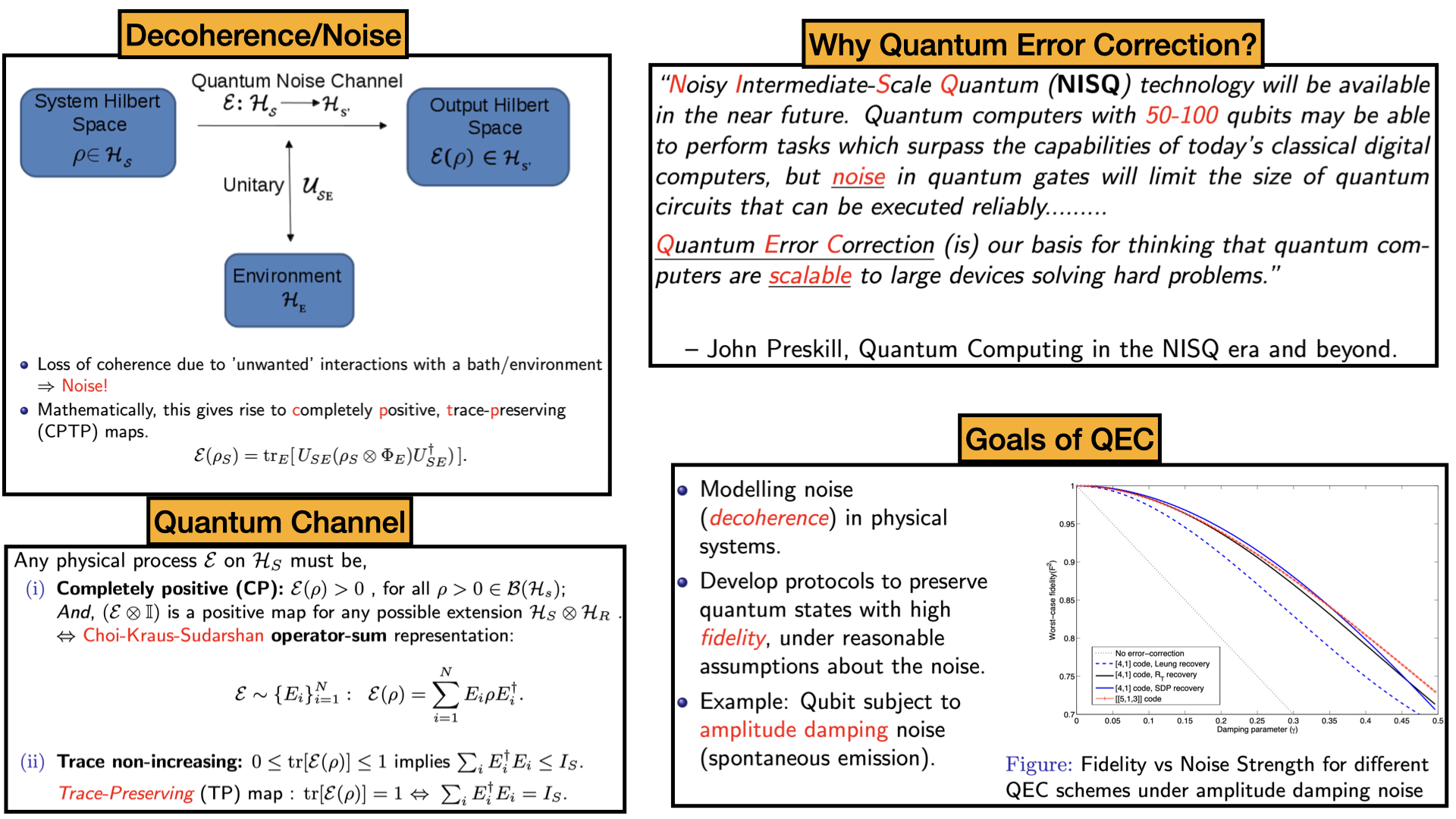
So any quantum computer design needs to be able to entangle all of the qubits and then control and measure them in a scalable way. Problems of decoherence/noise affecting qubits take us to the need for Quantum Error Correction (QEC). This is an error correction scheme to make fault-tolerant quantum computers using many entangled qubits together to represent one noise-free qubit. How many we need depends on how good the qubits are, but estimates are in the range of 100 to 1000 physical qubits to make one fault-tolerant qubit, which is many qubits brings us to scalability obstacles. Both algorithms and physical devices should be robust to make quantum computing and everyday reality. We need quantum computers with qubits in a million orders to break the current RSA encryption security using Shor’s algorithm, which is an essential concern worldwide. This application is itself enough to explain the importance of quantum error correction. Today we are in the Noisy intermediate-scale quantum (NISQ) era describes the current state of the art in fabricating quantum processors containing about 50 to a few 100 qubits. However, they are not advanced enough to reach fault tolerance nor large enough to profit sustainably from quantum supremacy. The term ’noisy’ refers to the fact that quantum processors are susceptible to the environment and may lose their quantum state due to quantum decoherence. In the NISQ era, quantum processors are not sophisticated enough to continuously implement quantum error correction. Intermediate-scale refers to the quantum volume related to the not-so-large number of qubits and moderate gate fidelity.
Noise-Adapted Quantum Error Correction to Adiabatic Quantum Computation
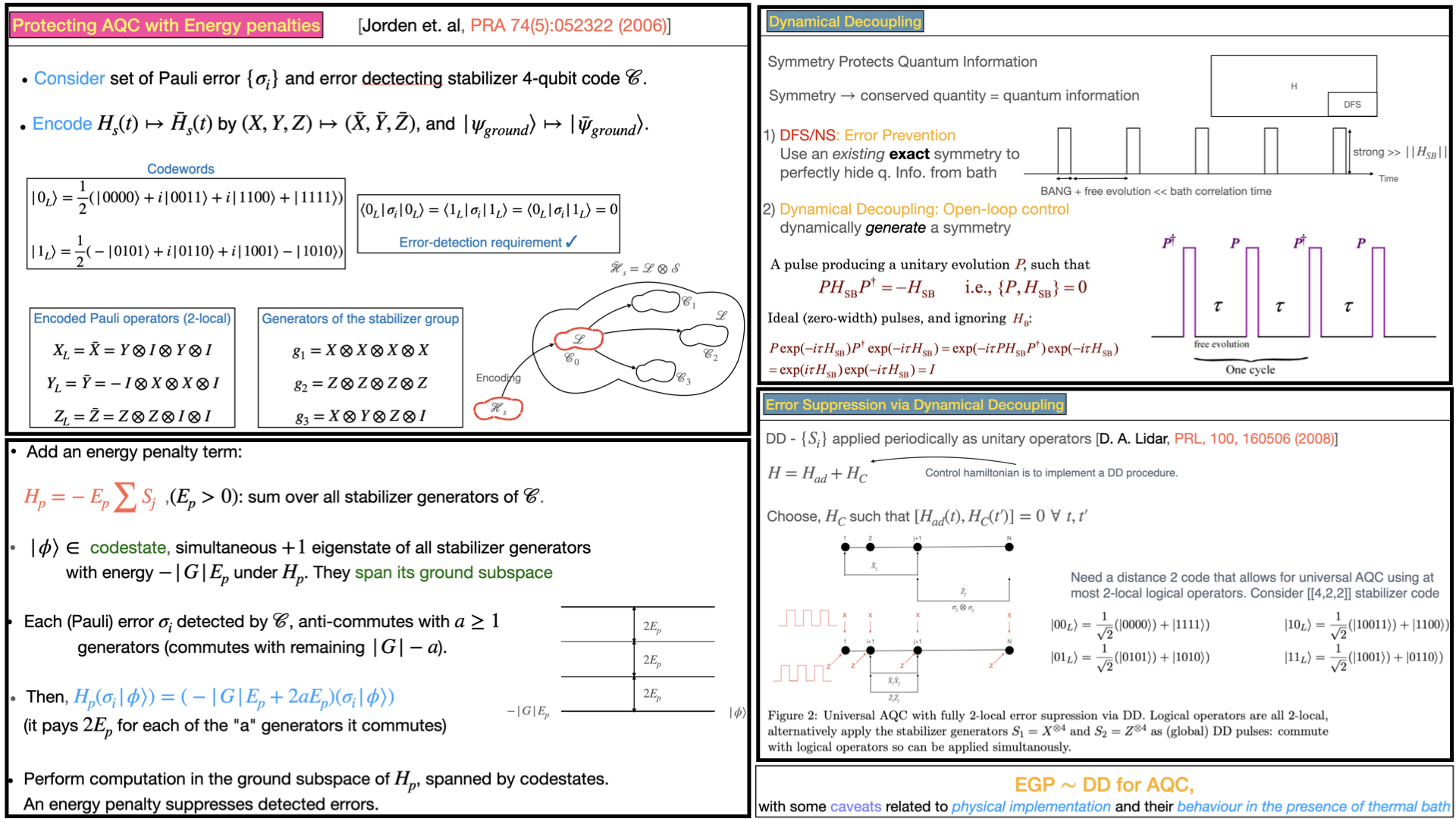
Active error correction for Pauli noise and Amplitude damping (non-Pauli error) for 2-local universal adiabatic quantum computation. Renormalising the system-bath coupling results error suppression. But, coupling cannot be eliminated completely without using an infinite amount of energy. Ex: DD pulses applied at an infinitely high frequency or an infinite strong EGP Hamiltonian. Since, our resources are finite. Physical error will accumulate over long time scales eventually causing logical errors! We can use classical post-processing, but as errors accumulate more, it results in Computation fails!
Decoherence is the uncontrolled interaction between system - environment degrees of freedom. For large scale quantum computation, developing robust quantum control techniques to mitigate the decoherence is imperative. For this, isolating the qubit from it’s environment is key. Understanding the spectrum of noise acting on a qubit can yield valuable information about its environment, as it crucially underpins the optimization of novel DD protocols that can mitigate such noise. In practice, the experimental noise spectrum varies significantly between different qubits in non-trivial ways to predict or accurately extract from the most common measurements. As a result, it is difficult to predict a priori which of the several possible DD protocols would provide optimal suppression of decoherence. Indeed, one could imagine constructing a decoupling protocol customized for a particular qubit, but this is only possible by knowing the actual qubit noise spectrum with sufficient accuracy. Also, it would be worth emphasizing that the knowledge of an obscured qubit environment is a valuable outcome of precise noise spectroscopy. As the number of qubits in a quantum computer grows, the complexity of the noise environment also increases. Rapid noise characterization techniques have become even more critical for managing these large-scale systems. Dynamical decoupling relies on tailoring pulse sequences to counteract specific noise frequencies. Rapid noise spectrum extraction allows for faster iteration and optimization of these protocols. It accelerates the development of robust quantum algorithms that enable real-time adjustments to error correction strategies based on the current noise environment. However, using standard methods, extracting accurate noise spectra from typical time dynamics measurements on qubits is intractable. Extracting the noise spectra rapidly for qubits presents several challenges. Conventional long-duration noise spectroscopy protocols require extended measurement times. These long measurement times contribute to decoherence, altering the noise they are trying to measure. The measured noise spectrum ends up being a distorted representation of the actual noise affecting the qubit.
There are various sources of noise, each with varying frequencies and characteristics. Thus, our methods must be sensitive enough to capture this complexity without sacrificing speed. Many traditional methods prioritize accuracy over speed, requiring extensive data collection and analysis. Achieving rapid extraction often compromises the level of detail captured in the noise spectrum. This trade-off can limit the effectiveness of the extracted data for optimizing error correction protocols. Noise can fluctuate over time; this time dependence on noise creates problems for lengthy noise spectroscopy protocols, making them unsuitable for accurately characterizing the qubit’s noise environment. To practical achieve fault-tolerant quantum computing , where errors can be effectively corrected, we need a deep understanding of the specific noise affecting the qubits, and rapid extraction of noise spectra becomes an imperative tool for overcoming noise challenges. Significant advances have been made in machine learning and specifically deep learning techniques, for example, in the fields of computer vision and natural language processing, and more recently, they have been applied to problems in physics and quantum engineering. Here, we propose to address this challenge of rapid noise spectroscopy using deep learning algorithms, motivated by past work on NV center qubits, a neural network-based methodology that allows for the extraction of the noise spectrum associated with any qubit surrounded by an arbitrary bath, with significantly greater accuracy than the current methods. While promising for rapid extraction, deep learning approaches require significant training data. Gathering this data can be time-consuming, especially for diverse noise environments. Our protocol effectively and efficiently addresses the challenges in accurately extracting qubit noise spectra from coherence decay measurements to understand and mitigate qubit noise environments and also outperforms conventional methods. This enables the customization of optimal DD protocols and improves the robustness of quantum control operations.
Finding near Optimal Dynamical Decoupling protocol using Machine Learning to suppress Noises in IBM Qubits
Robust isolation of a qubit from unwanted environmental noise is a critical factor in technologies such as quantum computers. Understanding the spectrum of noise acting on a qubit can yield valuable information about its environment and crucially underpins the optimization of dynamical decoupling protocols to mitigate such noise. To address this challenge we use deep-learning algorithms and demonstrate a neural-network-based methodology that extracts the noise spectrum associated with any qubit surrounded by an arbitrary bath. In practice, the experimental noise spectrum varies significantly between different qubits in ways that are non-trivial to either predict or, indeed, to extract from the most common measurements accurately. As a result, it is difficult to predict a priori which of the several possible dynamical decoupling protocols would provide optimal suppression of decoherence.
Quantum computers leverage the principles of quantum mechanics, such as interference, superposition (Bloch sphere), and entanglement, to perform certain types of calculations much faster than classical computers. These properties allow them to process a large number of possibilities simultaneously (Quantum parallelism).
Entanglement is a state where the state of one qubit is directly related to the state of another, even if they are physically separated. Changes to one qubit instantaneously affect the other, providing a form of correlation that can be exploited for computation, like the Control-NOT gate.
Quantum Gates are used to perform operations on qubits. They manipulate the quantum states of qubits and can perform complex operations more efficiently than classical logic gates.
Quantum Error Correction and Mitigation are two distinct approaches to address the challenges posed by errors in quantum computers.
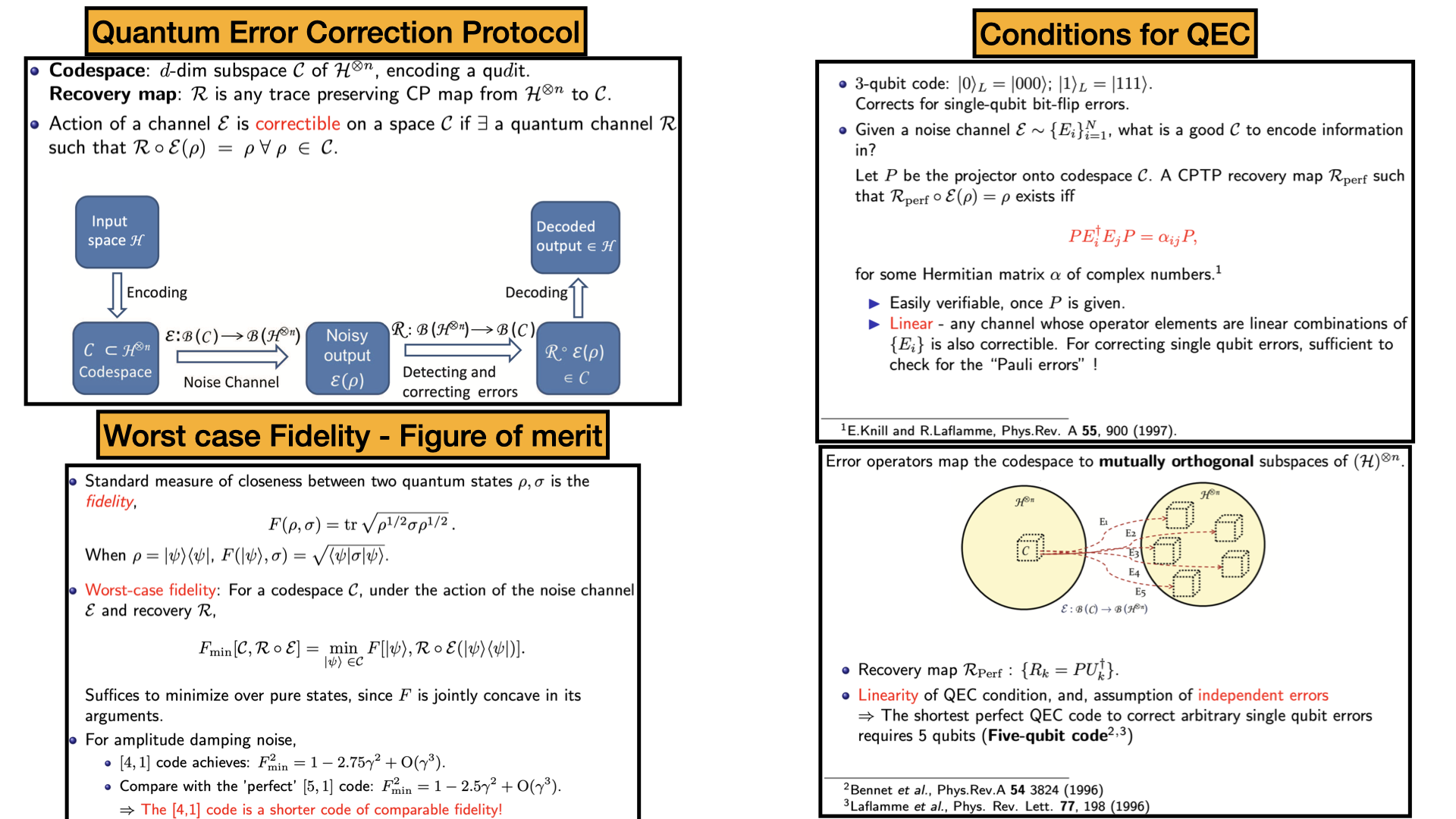
Quantum Error Correction
Purpose
Objective
Aims to protect quantum information from errors induced by quantum decoherence, environmental noise, gate and measurement imperfections.
Concept
Involves encoding quantum information in a way that errors can be detected and corrected without corrupting the information.
Key Components
Encoding
Information space to subspace of larger physical Hilbert space - Coding introduces redundancy.
Noise Channel
Noise process
Syndrome Extraction
Detection
Recovery Channel
Correction based on syndrome
Decoding
Back to information space
Challenges
Overhead
Resources required to protect, like 3-qubit code.
Fault Tolerance
Essential for large-scale practical computers when error rates are below a certain threshold.
Quantum Error Mitigation
Purpose
Objective
Aims to reduce the impact of errors on the outcomes of computation by doing classical post-processing, without explicitly correcting the error.
Concept
Instead of correcting errors, it involves estimation and compensating for the errors in the final results.
Approaches
Noise Models
Representing errors and imperfections. Error rates, decoherence mechanism, spatial and temporal correlations, damping (amplitude and Phase), random unitary, depolarisation.
Techniques
Richardson extrapolation, measurement error mitigation, and error amplification are methods used to adjust quantum results based on error models.
Practical Implementation
NISQDevices
Intermediate level of computational capability and their susceptibility to noise. NISQ devices are not fully fault-tolerant, meaning they can produce erroneous results. Not yet error-corrected but are used with error mitigation.
Hybrid Quantum Classical Approaches
Use quantum where parallelism is implementable.
Challenges
Accuracy
Depends on effectiveness of the noise models and assumptions made about the errors.
Cost
Require additional resources, reducing the advantage.
Error Suppression
Purpose
Purpose
Techniques that estimate and mitigate errors without fully correcting.
Quantum Dynamical Decoupling
Purpose
Aim to isolate the quantum system from its environment, reducing the impact of external noise.
Approach
By applying sequences of carefully timed pulses, the quantum system's evolution can be decoupled from its surroundings, minimizing errors caused by environmental interactions.
Hamiltonian Engineering
Purpose
Manipulating the system's Hamiltonian to suppress certain types of errors.
Approach
Adjusting the parameters to make it less sensitive to specific error sources, thereby reducing the likelihood of errors during computation.
Quantum Noise Channel: Understanding how quantum information is transmitted, manipulated, and affected by various sources of noise and imperfections in quantum systems. It is a mathematical description of how quantum systems evolve and interact with their surroundings. Mathematically, a quantum channel is described by a completely positive and trace-preserving (CPTP) map. A CPTP map ensures that the quantum channel is physically meaningful and preserves the probabilities, ensuring the total probability of all possible outcomes remains 1.